Rich designs, better results, stronger policies
Today, we have vaccines for many childhood illnesses. However, an estimated 20 million infants still go unvaccinated against preventable illnesses such as measles, Hepatitis B, and diphtheria. More than half of these children (60%) live in lower to middle-income countries. By strengthening routine vaccination programmes an additional 1.5 million children’s deaths could be avoided.

Immunization challenges
Many children go unvaccinated because of various challenges in the health system. These include a range of practical hurdles, from health worker shortages, logistical challenges, limited access to health facilities, to more subtle barriers, such as socioeconomic or gender discrimination. In some cases, implementation issues arise outside the health system, as a result of external factors, such as power outages or cut-backs in health spending due to economic crises.
With such a variety of obstacles, it is clear that no one-size-fits-all approach can help improve immunization programmes. “The problem is far deeper,” explains Dr Abdul Ghaffar, Executive Director of the Alliance for Health Policy and Systems Research (AHPSR). “The answer lies in looking at how immunization programmes operate across the health system and how real-world factors influence implementation. We can only understand these factors when we involve programme staff, health managers and policy makers throughout all phases of the research implementation process.”
Rich research designs
In search of practical solutions, the Alliance launched the third round of a Decision-maker Led Implementation Research workshop in Montreux, Switzerland from 22-26 August 2016. Ten teams, each included a programme manager and researcher, were selected from 7 lower-middle-income countries (Ethiopia, India, Kenya, Nigeria, Pakistan, Somalia and Uganda) following a call for proposals. Recognising the benefits of this training, a team from WHO’s Department of Nutrition for Health and Development also joined the training to inform its own implementation research agenda.
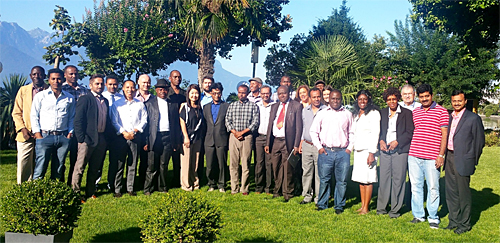
Facilitators from the AHPSR, and the Knowledge Management and Implementation Research Unit at UNICEF, with support from GAVI, the Vaccine Alliance, worked with the teams to improve their research proposals using a health systems perspective.
“Our immunization coverage rates are very low in some areas due to health worker shortage, logistics, difficult terrain and challenges reaching highly mobile populations. We have tried different approaches which are yielding results…but very slowly,” explains immunization programme implementer, Dr Mohammed Bello Kawuwa from Yobe State Ministry of Health, Nigeria.
“This workshop will help us undertake implementation research to get insights on how we can better strengthen our routine immunization programme,” stated Mr Kawuwa. ”We are determined to ensure that every child grows up healthy and productive. We cannot afford to miss even one child!”
Dr Nhan Tran who leads up the Alliance’s work on implementation research explains, “Very often it is the person in the field – the doctor in the remote rural clinic or the midwife working in the local community – who, facing some particular problem, asks the questions that become the starting point for new thinking and solutions.”
Better research results, stronger policies
Over the five days, the teams were coached on how to sharpen their research proposals. One of the greatest challenges facing the global health community is how to take proven interventions, implement them and bring them to scale. “Because implementation research is concerned with examining an issue in a real context which brings both the implementer and researcher together, you get richer findings, said co-facilitator Dr Kumanan Rasanathan, Senior Health Specialist, from UNICEF.
“They can see what would work on a practical level, what barriers may arise and what needs fixing to get the desired results. In this way we can promote the integration of research conclusions and evidence into health policies, which in turn improves the overall health care system,” added Dr Tran.
An enthused Dr Kawuwa concluded, “Now that I have this knowledge, I am excited that I will be able to influence future studies in Nigeria to use implementation research to uncover any hurdles to our work. These practical insights will improve not only our immunization programmes and policies, but other health system difficulties.”
Next steps
Participants have until the end of September to polish their proposals. After another round of adjudication, up to 10 teams will be awarded grants totalling US$100 000. Since the inception of the Decision-Maker Led Implementation Research programme in 2014, 16 research teams have been awarded funding.