Earlier this year, the Alliance started a new programme of work on Systems Thinking for Strengthening District Health Systems (ST-DHS). The initiative takes a unique approach by supporting countries to apply systems thinking tools and practices to understand and intervene in their local health system. The initiative will work with district teams, national-level officials and research institutions in three countries (Botswana, Pakistan and Timor-Leste) to adapt systems thinking tools and bring systems thinking practice to routine district health management. Country activities will be supported by the Technical Support Centre (TSC) based at the Swiss Tropical and Public Health Institute (SwissTPH) with expertise in systems thinking and district-level health systems strengthening.
What is systems thinking for health systems strengthening?
Health systems are complex adaptive systems with numerous stakeholders and competing priorities. Interventions that have been shown to be highly effective in some (controlled) settings often fail to achieve the expected goals when implemented at scale or integrated into the routine operations of health systems in low and middle-income countries (LMICs).
Understanding and intervening in complex health systems requires a set of approaches, methods and tools derived from systems thinking approaches– everything from process management and mapping, to policy structure modelling, systems dynamics modelling, causal loop diagramming and social network analysis. Systems thinking provides a new set of lenses for health system stakeholders, allowing them to understand and intervene in complex systems with a systems approach. Systems thinking places an emphasis on the interactions among different health system actors and highlights the importance of the processes and procedures in which actors are embedded.
Why systems thinking for district management?
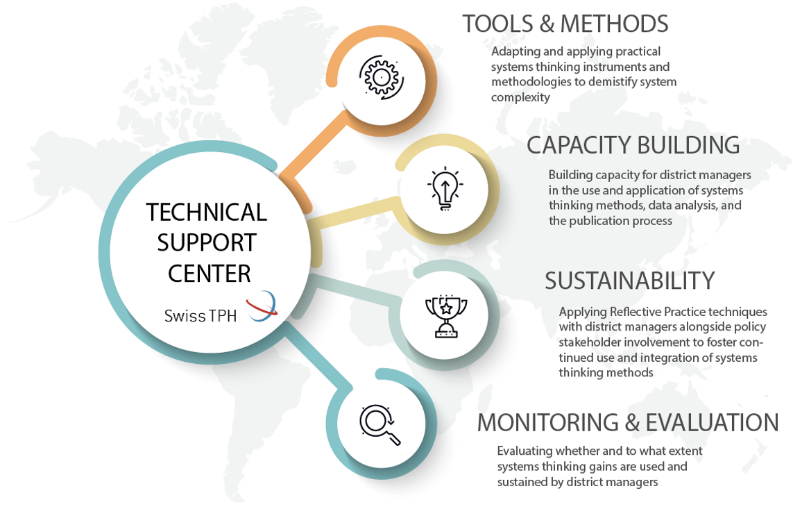
District health managers translate national and regional health policies and strategies into actionable plans to provide health services and meet the overall goals and targets. They are responsible for the operationalization of health policies and for the integration of different disease specific programs. Increasing greater systems awareness in district health managers may better enable them to identify more holistic and sustainable solutions to the challenges they face in coordinating health services. ST-DHS hypothesizes that:
- providing district managers with useable systems thinking tools and methods;
- facilitating a change in mindset towards a systems approach; and
- embedding reflective practice in managers’ planning and budgeting cycles
will not only shape the way district managers understand and intervene in their local health systems, but will also sustain these changes after the intervention.
District team members are at the centre of the design, planning and adaptation of systems thinking tools, meaning their needs drive the face-to-face training, final selection of tools, and focus areas of work.
Kick-off workshop
A few weeks ago, participants from Pakistan, Timor-Leste, Botswana, the Alliance and the SwissTPH came together to reflect and plan the next two years of work.
Unlike some other multi-country initiatives, there was no pre-defined intervention to be implemented. All actors came together to design how the initiative would look in each country. To do so, participants received input on the theory and rationale behind systems thinking and were exposed to different systems thinking tools.
The first “aha moments” occurred early on in the workshop. National and district participants realized the complexity of their own systems and the dynamic interaction among the different stakeholders. During these exercises, countries got to learn from each other`s systems. These discussions and experiences led to each country brainstorming how they want to frame and design the initiative.
The teams will continue working on this framing and defining the health system challenge they will address. In addition, they will decide which systems thinking tools they want to work with, and the technical support centre will start adapting these in the coming months.
Country teams are in the midst of their preparatory activities, which include diverse meetings to engage local actors, identify areas of work and map potential data sources. The TSC is currently working on the tools and plans to visit each country in early 2020.